

30-day money-back guarantee, less shipping and any fees.
Empirical Audio Off-Ramp 5
Low-jitter USB digital audio converter
This is the simplest way to play audio through your existing DAC using a computer. It can replace your CD transport, and deliver better sound quality.
The Off-Ramp 5 is a fifth-generation product that provides a USB computer interface to your audio system with unprecedented sound quality. The Off-Ramp 5 supports sample-rates of up to 24/192 and uses Asynchronous USB protocol*, which is optimum for reducing jitter. A custom Software Driver is provided and must be loaded for the Mac or PC. This driver has been shown to be more reliable and trouble-free than the native Microsoft driver.
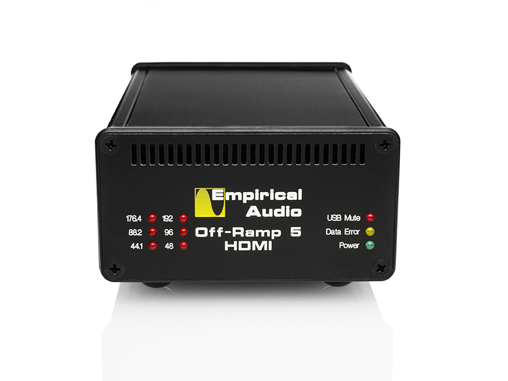
The Off-Ramp 5 includes an HDMI I2S output, so that DACs with these inputs including PWD and W4S can be driven directly, avoiding S/PDIF conversions (Note: The Off-Ramp 5 works with the PWD HDMI I2S in Native Mode only. This utilizes the clock of the OR5. The other modes do not.) It also has sample-rate LEDs that indicate the sample-rate of the track that is being played by the computer. No sample-rate changes take place in the Off-Ramp 5. The data is not modified. It is bit-perfect playback.
The Off-Ramp 5 voltage regulators now include a main Hynes regulator and USB Hynes regulator. Optional Hynes regulators can be added for S/PDIF and HDMI if the customer desires these outputs to be further improved.
The Off-Ramp 5 allows you to add a high-performance USB interface to your existing non-USB DAC. It can also improve the existing computer interface on your USB or Firewire DAC. Most DACs with computer interfaces will sound better when an Off-Ramp 5 is used to drive their S/PDIF, AES/EBU or HDMI I2S input.
The Off-Ramp 5 is a reference quality 24/192 interface that will outperform the very best and most expensive CD transports and music servers as well as for the first time, competing with vinyl. The difference between the Off-Ramp 5 and other manufacturers converters is not subtle. The Off-Ramp 5 delivers clarity, depth, width and imaging that is unmatched. This interface was used in the system that won a best sound of show from TAS at both the 2010 and 2011 Rocky Mountain Audio Fest. Off-Ramp is listed in Editors Choice Awards of TAS and Recommended Components of Stereophile.
John Atkinson, editor of Stereophile writes:
“the Off-Ramp 4 will give the best sound quality I have heard from an outboard USB converter”
Stereophile review, 2011
What configuration to choose
We have tried to make this simpler by reducing options in the Off-Ramp 5. The outputs can be improved with these upgrades:
If you want the S/PDIF or AES/EBU output to be improved, add the S/PDIF Hynes Reg option. AES is a lesser improvement.
If you want the HDMI I2S or RJ-45 I2S output to be improved, add the HDMI Hynes Reg option
These upgrades improve the imaging, clarity, depth, width and slam of the presentation.
Clock upgrades are available from the standard custom clocks. Turboclock is our best lowest jitter clock, which uses two Hynes voltage regulators. Turboclock takes the Off-Ramp 5 to a new level, well ahead of the competition. The difference with Turboclock is a more focused, 3-D image with improved bass punch and tightness.
OTL option (Output TransformerLess)
This option affects the S/PDIF output only. The OTL option reduces jitter at least 50% from the standard Off-Ramp 5 by removing the transformer for the S/PDIF output and changing some associated circuitry. If you have a DAC that already has a transformer on the S/PDIF input (galvanically isolated from ground), then this is an attractive option for you. It is unneccesary to have 2 transformers in series and one at the DAC input is more optimal than one at the Off-Ramp 5.
Dynamo power supply upgrade
The Dynamo power supply is an upgrade for the standard AC adapter "wall-wart" that comes with the Off-Ramp 5. The Dynamo is a linear supply with Hynes regulation that is optimized for the Off-Ramp 5. The cabinetry matches the Off-Ramp 5, so it can be placed on top, bottom or to the side. It comes with an umbilical cable to connect to the Off-Ramp 5. Customers have reported improved dynamics, more detail, better transparency and a greater sense of ease when using this supply with the Off-Ramp 5. "A great value". Use the configuration pull-down menu to add the Dynamo power supply to your order.
BNC-BNC 4-foot cable option
This is a 75 ohm low-loss cable that Empirical Audio makes. It has true 75 ohm BNC connectors. The 75 ohm coax cable contains a center pure silver conductor and silver-plated copper shield over foil. The dielectric is expanded Teflon. We recommend this cable to go with the OTL option. The BNC-BNC cable comes with two 75 ohm RCA adapters so you can connect to any S/PDIF coax connector.
Minimizing Jitter
Jitter is the inaccuracy in the timing of the digital data. It is not data errors, it is inaccuracies in the timing of the presentation of the data to the D/A converter. This is different than sending digital data to a printer for instance, or even a hard-disk. These data transfers are not ‘real time’. Streaming audio data from a CD transport or a computer source is real-time because the D/A converter creates a real time analog signal from the data each time a new data word is presented. If the timing of the presentation of each word is inaccurate, this causes frequency modulation distortion. There is nothing that can be done about the samples in the recording and the clock that was used to make those samples, but playback jitter can be minimized.
The Off-Ramp 5 virtually eliminates the sibilance and harshness due to jitter, making your digital closer to analog. Once jitter is minimized, the clarity, image focus and dynamics are improved significantly. Recordings of rain, thunderstorms, violins, cellos, bongos and timpani are finally lifelike. One of the obvious improvements of the Off-Ramp 5 over the previous generation Off-Ramp 4, is the rendering of brass. Very lifelike. The Off-Ramp 5 is so good at reducing USB jitter that it is used by reviewer Steven Stone of TAS and John Atkinson of Stereophile.
Features
Clocks
Two clocks are required in the Off-Ramp 5. These clocks are the oscillators that move the datastream from the Off-Ramp 5 to the DAC. Since the computer clock is not used for D/A clocking, except for moving blocks of data into the Off-Ramp 5, these two internal clocks are the real-time ‘Master’ clocks. The jitter of these is critical. Two clocks are needed to cover all sample-rates because these clocks are free-running without any PLL. Two standard low-jitter custom clocks are provided on the standard version. All sample-rates are generated by dividing-down the frequency of these two clocks. Because the sample rate groups are not mathematically related, the two clocks generate the following two sample-rate groups:
- 44.1/88.2/176.4kHz
- 48/96/192kHz
The Off-Ramp 5 automatically selects the clocks for each sample-rate. Some software, such as Vista, Win7 or iTunes on Mac OS will not automatically change sample-rates to match the music file. For these it is important to manually change the sample-rate in the OS settings, or use a player software that overrides this and changes sample-rates automatically, such as Amarra or Pure Music on Mac. Otherwise, some of these will perform sample-rate conversion.
USB cables
With the Off-Ramp 5 Asynchronous USB interface, the USB cable is less important. We have achieved wonderful results using the included 5m Belkin Gold. However, using a more expensive USB cable may produce better results, depending on your system and AC power.
Power
The Off-Ramp 5 has a DC input power jack with 2.5mm pin. Center is positive. It is protected from reverse voltage. The included AC adapter provides excellent results, but can be replaced with an adapter or linear supply that floats or with earth ground connected to negative. We recommend at least 1 amp @ 12VDC. The high-speed switching supplies used by Empirical Audio are critical to the performance of our products. They respond much more quickly to current demands than Linear supplies. Our regulators and internal filtering do a good job of eliminating any RF from the switching regulator power.
I2S output
I2S is a more direct D/A interface than S/PDIF. It was developed by Philips when Philips and Sony created the CD format and the S/PDIF interface specification. I2S is a three or four-signal interface that includes clocks. This is the native interface for most D/A chips. Therefore if one can drive I2S directly and avoid S/PDIF translation, there is the opportunity to reduce jitter even more. Empirical Audio standard I2S interface uses 4 signals and 4 returns and the RJ-45 connector. It is compatible with I2S on several other manufacturers DACs, including Stello, Perpetual Technologies and Northstar, as well as our own Overdrive DAC.
I2S RJ-45 connector pinout
Pin 1 - SCLK
Pin 2 - SCLK return
Pin 3 - SDATA
Pin 4 - SDATA return
Pin 5 - L/RCLK
Pin 6 - L/RCLK return
Pin 7 - MCLK
Pin 8 - MCLK return
Specifications
 Download User Manual
Inputs
- USB 2.0 from Mac or PC, up to 5 meter USB cable
- +12VDC power – AC Adapter included, or optional Monolith LI Battery Power Supply DC connector is 2.5mm pin, center positive. 1 Amp @ 12VDC minimum required
Outputs (all outputs are active)
- Isolated S/PDIF coaxial – 75 ohm Canare BNC jack
- AES/EBU – XLR male
- I2S on RJ-45, Empirical Audio standard (5V, optional 3.3V) output impedance is 120 ohms
- I2S on HDMI - LVDS format, pin compatible with PSAudio and Wired for Sound DACs.
Compatibility
The Off-Ramp 5 is designed to work with all 2-channel DACs and SS receivers/processors. It will not pass AC-3 surround-sound or DSD . It is compatible with Mac OS's from Tiger to Mavericks or PCs running XP, Vista, Win7 and Win8. Device drivers are provided for both Mac and PC.
Output Performance
The four Off-Ramp 5 outputs are all similar in performance. It is best to select the best performer on the input of your DAC.
Included
- Off-Ramp 5
- 5 meter USB cable
- BNC to RCA adapter plug
- +12VDC AC adapter
- CDROM with PC/Mac installation software
Options
- S/PDIF Hynes voltage regulator
- HDMI Hynes voltage regulator
- Dual Turboclock upgrade
- Dynamo power supply
- BNC-BNC S/PDIF coax cable with RCA adapters
30-day money-back guarantee, less shipping and any fees.
Download Drivers
- Windows 7 / Vista
- Windows XP / 2003
- Mac OSX 10.6 Snow Leopard
- Mac OSX 10.5 Leopard
- Mac OSX 10.4 Tiger
Configure Your Off-Ramp 5
*USB software and firmware licensed from M2Tech